
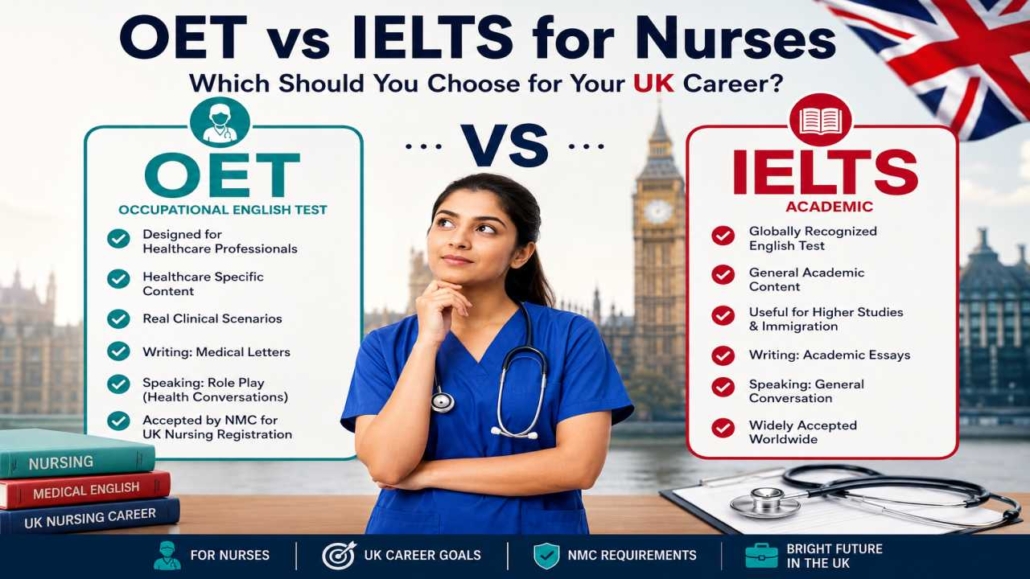
OET vs IELTS for Nurses: Which Should You Choose for Your UK Career?
If your primary goal is to work as a nurse in the UK, the Occupational English Test (OET) is often the preferred option because it is specifically designed for healthcare professionals. However, IELTS Academic remains an excellent choice for nurses who want broader international opportunities beyond healthcare. The right exam depends on your career goals, language strengths, and future plans.
OET vs IELTS for Nurses: Understanding the Best Path to a UK Nursing Career
Thousands of international nurses dream of building a successful career in the United Kingdom every year. Before starting the Nursing and Midwifery Council (NMC) registration process, candidates must prove their English language proficiency through an approved exam. This is where the OET vs IELTS for Nurses debate begins.
Many nurses spend weeks comparing exam formats, score requirements, preparation strategies, and difficulty levels. If you are planning to work for the NHS or other healthcare organizations in the UK, choosing the right English proficiency test can save both time and money.
At institutions such as Global NextGen Pro Chandigarh, many aspiring nurses seek guidance on whether OET or IELTS is the better option for UK nursing registration. The answer is not always straightforward because both exams are accepted by the NMC and offer different advantages.
What is OET?
The Occupational English Test (OET) is an English language examination designed specifically for healthcare professionals, including nurses, doctors, pharmacists, and physiotherapists.
Unlike general English exams, OET focuses on real healthcare situations that professionals encounter in hospitals, clinics, and healthcare settings.
The OET Nursing Module includes:
- Listening to healthcare consultations
- Reading medical documents
- Writing referral or discharge letters
- Speaking through patient-focused role plays
Because of its healthcare-focused content, many nurses find OET more relevant and practical than other English language tests.
What is IELTS Academic?
IELTS Academic is one of the most recognized English language examinations in the world. It evaluates a candidate’s ability to communicate effectively in academic and professional environments.
The IELTS exam format includes:
- Listening
- Reading
- Writing
- Speaking
Unlike OET, IELTS does not focus on healthcare situations. Instead, candidates must deal with academic reading passages, essay writing tasks, and general discussion topics.
For nurses who may pursue further education, immigration, or international career opportunities beyond healthcare, IELTS offers wider recognition globally.
Which is Easier for Nurses?
One of the most common questions among overseas nurses in the UK migration process is:
Which is easier, OET or IELTS?
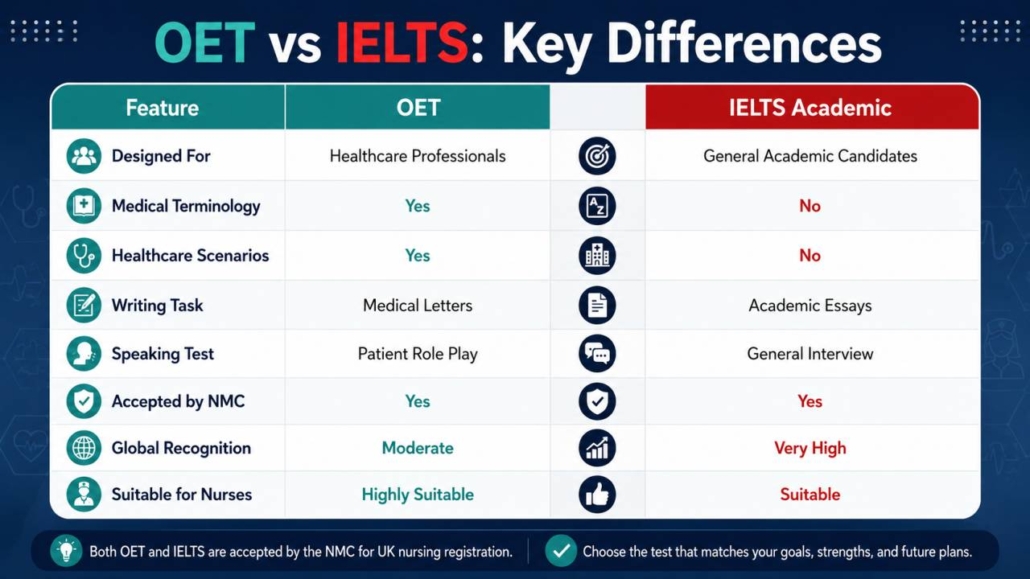
There is no universal answer, but many healthcare professionals report that OET feels easier because the content is directly related to nursing practice.
For example:
- OET writing for nurses involves referral letters and patient communication.
- IELTS writing task for nurses requires academic essays that may be unfamiliar to healthcare workers.
Similarly, OET speaking sessions simulate real patient interactions, while IELTS speaking involves discussing a variety of unrelated topics.
For nurses who use medical terminology daily, OET often feels more natural and comfortable.
NMC English Language Requirements
The Nursing and Midwifery Council accepts both OET and IELTS for nursing registration in the UK.
To meet NMC English language requirements, candidates generally need to achieve the required scores across all four language skills.
Typical requirements include:
OET Score for UK Nurses
- Grade B in Listening
- Grade B in Reading
- Grade B in Speaking
- Required writing score as per current NMC guidelines
IELTS Score for UK Nurses
- Overall Band Score: 7.0
- Minimum required scores in individual modules according to current NMC standards
Candidates should always verify the latest requirements directly from the NMC before booking an examination.
Benefits of OET for Nurses
Healthcare-Focused Content
Every section is designed around real healthcare communication.
Better Professional Relevance
The exam reflects situations nurses experience daily.
Practical Writing Tasks
Instead of essays, candidates complete healthcare-related writing tasks.
Strong Preparation Alignment
Nurses can prepare using their existing medical knowledge.
Accepted by the UK Healthcare Sector
OET is widely accepted for nursing registration and healthcare employment.
Benefits of IELTS for Healthcare Workers
Global Recognition
IELTS is accepted by universities, employers, and immigration authorities worldwide.
Multiple Career Opportunities
Useful for education, migration, and professional development.
Extensive Study Resources
Candidates can access thousands of preparation materials.
International Acceptance
IELTS accepted countries include the UK, Canada, Australia, New Zealand, and many others.
OET Preparation Tips
Many successful candidates at Global NextGen Pro Chandigarh recommend the following preparation strategies:
- Practice healthcare communication daily.
- Learn referral and discharge letter structures.
- Improve medical vocabulary.
- Complete official OET practice tests.
- Focus on patient-centered communication.
IELTS Preparation Tips
To improve IELTS performance:
- Practice essay writing regularly.
- Develop academic reading skills.
- Build advanced vocabulary.
- Take timed mock examinations.
- Improve speaking confidence through regular conversations.
Common Mistakes Nurses Make
Many nurses fail because they underestimate the exam.
Common mistakes include:
- Ignoring exam patterns
- Weak time management
- Limited writing practice
- Poor understanding of scoring criteria
- Lack of mock test experience
Whether you choose OET or IELTS, structured preparation is essential.
Real-Life Career Perspective
Imagine two nurses applying for NHS jobs.
The first nurse chooses OET because she is comfortable with healthcare communication. She successfully completes her OET nursing module and progresses through the NMC registration process.
The second nurse chooses IELTS because she plans to pursue higher education in the future. While preparation takes longer, the broader acceptance of IELTS supports her long-term career goals.
Both nurses eventually secure UK healthcare jobs, proving that success depends more on choosing the exam that matches your strengths than simply selecting the most popular option.

