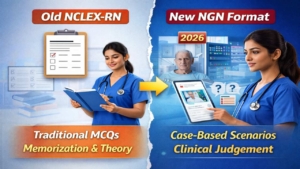
NCLEX-RN 2026 Changes: What Indian Nurses Must Know About the New Exam Pattern

For thousands of Indian nurses aiming to build a career abroad, the NCLEX-RN is more than just an exam—it’s the gateway to global opportunities. Countries like the US and Canada require this license to ensure that nurses are ready for real clinical environments.

However, in 2026, the exam is no longer what it used to be.

With the introduction of the Next Generation NCLEX, the entire approach to preparation has shifted. The New NCLEX-RN Format now focuses less on memorization and more on how well you can think, analyze, and make decisions in real-life situations.

Understanding the New NCLEX-RN Format (NGN)

The Next Generation NCLEX Explained in simple terms means one thing: the exam is now designed to test your practical nursing ability.

Earlier, many questions were direct and theory-based. Students could rely heavily on notes and repeated practice of similar questions. But now, the New NCLEX-RN Exam Pattern challenges you to apply your knowledge in unfamiliar situations.

You are no longer just recalling facts—you are expected to connect concepts, interpret patient data, and make safe clinical decisions. This change reflects real hospital settings, where no two cases are exactly the same.

What Has Actually Changed in the Exam?

The structure of the exam has evolved significantly, but not everything is complicated if you understand it properly.

The biggest shift is the introduction of case-based questions. Instead of answering one question at a time, you may now face a full patient scenario followed by multiple related questions. This requires continuous thinking and analysis rather than isolated answers.

At the same time, clinical judgment has become the core focus. You are expected to identify problems, decide priorities, and choose the safest action—just like you would in a real ward.

Another important change is the partial scoring system. Unlike the older pattern, you can now earn marks even if your answer is partially correct. This makes the evaluation more realistic, as nursing decisions in real life are often not simply right or wrong.

To support these changes, new question formats such as matrix questions, drag-and-drop, and multiple-response items have also been introduced. These formats test how deeply you understand a concept rather than how well you remember it.

Why This Shift is Important for Indian Nurses

For many Indian nursing students, the traditional learning style has been focused on theory, textbooks, and memorization. While this approach helps in academic exams, it does not fully prepare candidates for the New NCLEX-RN Format.

This is why many students initially find the updated pattern challenging.

But this challenge also brings an opportunity. Indian nurses who adapt to this new approach often find themselves better prepared—not just for the exam, but also for real clinical work abroad.

In fact, regions like Kerala, which have a strong history of sending nurses overseas, are already seeing a shift in how students prepare. The focus is gradually moving toward understanding concepts and applying them practically.

How Should You Prepare for NCLEX-RN 2026?

How Should You Prepare for NCLEX-RN 2026

Preparing for the updated exam is not about studying more—it’s about studying smarter.

First, you need to move beyond memorization. Instead of just reading notes, try to understand the logic behind every answer. Ask yourself why a particular option is correct and how it would work in a real patient situation.

Second, regular practice with case-based questions is essential. Since the exam is now scenario-driven, this type of practice helps you build confidence and improve your thinking ability.

You should also start developing a clinical mindset. When you study any topic, think in terms of patient care:

  • What is the priority here?
  • What could go wrong?
  • What action should be taken first?

These small shifts in thinking can make a big difference in your performance.

At the same time, using updated study materials aligned with the New NCLEX-RN Exam Pattern is crucial. Outdated resources may not reflect the current exam style and can slow down your progress.

Also Read This: Tips for Passing the NCLEX Exam on Your First Attempt

How Coaching and Training Are Evolving

Training institutes across India are also adapting to this change. Many coaching centers are now focusing on concept-based learning rather than just providing notes.

They are introducing:

  • Case-based discussions
  • Simulation-style practice questions
  • Real exam-like mock tests

This shift shows that the entire preparation ecosystem is aligning with the Next Generation NCLEX Explained approach.

Students who engage in this type of learning often develop stronger clinical reasoning skills, which helps both in the exam and in actual job settings abroad.

Is the New NCLEX-RN More Difficult?

This is one of the most common questions among aspirants.

The answer is not straightforward. The exam is not necessarily more difficult in terms of syllabus, but it is definitely more demanding in terms of thinking ability.

If you rely only on memorization, it will feel harder. But if you focus on understanding and application, the exam becomes manageable—and even logical.

In many ways, the new pattern is actually better because it prepares you for real-world nursing responsibilities instead of just testing theoretical knowledge.

What This Means for Your Nursing Career Abroad

The changes in the NCLEX-RN reflect a global shift in healthcare expectations. Hospitals today need nurses who can think critically, make quick decisions, and handle complex patient situations.

This means that clearing the exam is no longer just about passing a test—it’s about proving that you are ready for international clinical practice.

For Indian nurses, this is a moment of transformation. Those who adapt to the New NCLEX-RN Format early will have a clear advantage in both exams and job opportunities.

The Road Ahead for NCLEX Aspirants

The future of nursing is becoming more skill-focused, and exams like NCLEX-RN are evolving accordingly. While the changes may seem challenging at first, they are ultimately designed to create better, more capable healthcare professionals.

If you approach your preparation with the right mindset—focusing on concepts, practicing consistently, and thinking like a nurse—you can successfully clear the exam and build a strong career abroad.

Need Expert Guidance?

If you’re planning to prepare for the NCLEX-RN and want the right direction, expert support, and updated training, GlobalNext Genpro can guide you at every step—from preparation to placement.

Your journey to an international nursing career starts with the right strategy

NCLEX or OET: Which is Better for Nurses in 2026?

Many nurses who plan to work abroad often feel confused and search “nclex or oet which is better” or “nclex or oet which is better for nurses in 2026.” This confusion is very common, especially for beginners.

The truth is simple—NCLEX and OET are not competitors, but they are both important depending on your career path. In this guide, we will explain NCLEX vs OET in a very easy way so that even a beginner can clearly understand what to choose.

What is NCLEX?

The NCLEX-RN is a licensing exam that checks whether you are ready to work as a professional nurse.

It is conducted by the National Council of State Boards of Nursing and is mainly required in the United States. This exam tests your clinical knowledge, decision-making ability, and how you handle patient care situations. In simple terms, NCLEX is the exam that gives you permission to work as a nurse in the USA.

What is OET?

The Occupational English Test is an English language test specially designed for healthcare professionals like nurses and doctors.

Unlike NCLEX, this exam does not test your medical knowledge. Instead, it checks how well you can communicate in English in a healthcare environment—like talking to patients, writing reports, and understanding instructions. In simple words, OET proves that you can communicate effectively in English as a nurse.

NCLEX vs OET: Understanding the Core Difference

When comparing NCLEX vs OET for nurses, many people think one is easier or better than the other. But the reality is different.

NCLEX is all about your medical and clinical skills, while OET focuses on your English communication skills. One helps you become a licensed nurse, and the other helps you meet language requirements.

Key Differences:

  • NCLEX → Licensing exam
  • OET → English proficiency test
  • NCLEX → Required for USA
  • OET → Required for UK, Australia
  • NCLEX → Clinical questions
  • OET → Language-based tasks

So, if you are searching nclex or oet which is better, the correct answer is:
It depends on your goal, not on difficulty.

NCLEX or OET Which is Better for Nurses in 2026?

Now let’s directly answer the main question in a clear way.

If your dream is to work in the United States, then NCLEX is the right choice because it is mandatory for getting a nursing license there. Without passing NCLEX, you cannot legally work as a nurse in the USA. On the other hand, if you are planning to move to countries like the UK or Australia, then OET becomes important because it proves your English proficiency, which is required for registration.

So the answer to nclex or oet which is better for nurses in 2026 is:

  • Choose NCLEX → If your goal is USA
  • Choose OET → If your goal is UK/Australia

Choosing Based on Your Destination (Very Important)

Your career destination plays the biggest role in this decision.

If you are targeting the USA, your main focus should be NCLEX preparation along with basic English requirements. For the UK, you will need to clear OET (or IELTS) before moving forward with other steps like CBT and OSCE.

This is why understanding NCLEX vs OET properly is very important. It helps you avoid wasting time and money on the wrong exam.

Can You Skip One of These Exams?

Many students try to find shortcuts and often ask if they can skip one exam.

The simple answer is no.

Each country has its own rules, and you must follow them. If a country requires OET, you cannot replace it with NCLEX. Similarly, if NCLEX is required, you must pass it. Skipping exams can delay your career, so always follow the correct pathway.

Difficulty Level: NCLEX vs OET

Let’s understand this in a very simple way.

NCLEX can feel difficult if your nursing basics are not strong because it tests real-life patient scenarios. You need critical thinking and good clinical knowledge. OET, on the other hand, can feel challenging if your English is weak. It requires good grammar, vocabulary, and communication skills in a medical context.

So instead of asking which is easier, ask yourself:
What are you stronger in—nursing knowledge or English?

Smart Tips for Nurses in 2026

Here are some practical tips that can help you make the right decision:

  • Decide your country first
  • Understand exam requirements clearly
  • Focus on one exam at a time
  • Practice regularly
  • Avoid confusion by following a clear plan

These small steps can make a big difference in your journey.

Career Opportunities After NCLEX and OET

Both exams open doors to amazing opportunities.

With NCLEX, you can work in the USA where salaries and career growth are very high. With OET, you can enter countries like the UK, where the process is structured and faster for many international nurses.

Your success depends more on your preparation and consistency than the exam itself.

Need Expert Guidance?

If you are still confused about NCLEX vs OET for nurses, getting the right guidance can save you a lot of time.

At GlobalNext Genpro, we help nurses with:

  • Proper exam guidance
  • Personalized study plans
  • Practice sessions
  • Complete support for international nursing careers

With expert support, your journey becomes much smoother and faster.

Final Verdict: NCLEX vs OET

Let’s make it crystal clear:

NCLEX and OET are both important, but for different reasons. One gives you a license, and the other proves your language skills. So, if you are still wondering “nclex or oet which is better”, remember this:

There is no better exam—only the right exam for your goal.

How to Prepare for IELTS at Home Without Coaching in 30 Days

Introduction: The Power of Self-Study in 2026

Preparing for the IELTS exam at home is no longer just a secondary option; it has become the preferred choice for top-scoring candidates globally. Whether you are a healthcare professional like a nurse or doctor aiming for international registration, or a student planning your journey to a global university, understanding how to prepare for IELTS at home gives you a level of flexibility that coaching centers simply cannot match. The common misconception is that a high band score requires expensive physical classes. In reality, with the right discipline and a structured IELTS self study plan, you can master the nuances of the English language from your own living room.

This comprehensive guide is designed to transform your approach over the next 30 days. We will dive deep into the examination’s DNA, moving beyond basic tips to provide a strategic roadmap. By the end of this article, you will understand not just the what but the how of achieving a 7.5+ band score without spending a fortune on coaching.

Understanding the IELTS Test Format: Your First Step to Success

Before you begin your IELTS preparation at home, it is absolutely critical to understand the battlefield. The International English Language Testing System is a standardized test, which means it follows a very rigid pattern. If you don’t know the format, even native-level English won’t save you from losing marks on technicalities.

The test is divided into four modules: Listening, Reading, Writing, and Speaking. The Listening and Speaking components are the same for everyone, while the Reading and Writing tasks differ depending on whether you are taking the Academic or General Training version.

  • Listening (30 Minutes): You will listen to four recordings of native English speakers and then write your answers to a series of questions.

  • Reading (60 Minutes): This section consists of 40 questions, designed to test a wide range of reading skills including gist, main ideas, detail, and understanding logical arguments.

  • Writing (60 Minutes): You are required to complete two tasks. Task 1 usually involves describing visual information (Academic) or writing a letter (General), while Task 2 is a formal essay.

  • Speaking (11–14 Minutes): A face-to-face interview with an examiner, split into three parts that increase in complexity.

The 30-Day IELTS Self Study Plan: A Week-by-Week Roadmap

To succeed without a coach, you need a schedule that mimics a professional training environment. A random approach is the biggest reason for failure. Instead, follow this structured IELTS study plan to ensure you cover every aspect of the exam.

Week 1: The Immersion Phase In the first seven days, your goal is to live in the English language. This is particularly vital for IELTS preparation tips for beginners. Start by taking an official IELTS mock test to see where you stand. Once you have your baseline score, spend this week consuming English media. Listen to podcasts, read international news editorials, and start a vocabulary journal. Your focus should be on the Input skills—Listening and Reading. Understand how to identify distractors in the audio and how to manage your time during the long reading passages.

Week 2: Mastering the Art of Output During the second week, shift your focus to Writing and Speaking. These are the sections where most students struggle to get a high band. Start practicing your essay structures. For Writing Task 2, learn how to write a strong thesis statement and how to support your arguments with relevant examples. For Speaking, record your responses on your phone and play them back. You will be surprised at how many filler words like, umm or actually you use. Eliminating these is a key IELTS exam strategy to boost your fluency score.

Week 3: Speed, Accuracy, and Refinement By week three, you should be familiar with all question types. Now, it is time to work on your speed. In the Reading section, you only have 20 minutes per passage; you must learn to stop reading every word and start scanning for answers. This is also the week to perfect your grammar. Focus on complex sentence structures and punctuation. For doctors and nurses, ensuring that your formal tone is consistent throughout your writing tasks is essential to impress the examiner.

Week 4: Final Simulations and Confidence Building The final week is all about the IELTS mock test. You should aim to complete one full-length test every day under real exam conditions—no breaks, no phone, and strict timing. This builds the mental stamina required for the 2 hour and 45-minute ordeal. Review every mistake you make in these mocks. If you missed a True/False/Not Given question, go back and find out exactly why you misunderstood the text.

Read this also: Salary of Nurses in UK: What Indian Nurses Should Expect

IELTS Preparation at Home: Essential Section-Specific Tips

When you are learning how to prepare IELTS at home, you need to have a cheat sheet of strategies for each module. These small adjustments can often be the difference between a Band 6.5 and a Band 7.5.

The Listening Module

  • Predict the Context: Before the audio starts, read the questions. If the question asks for a Phone Number, your brain should be ready to hear digits.

  • Spelling is Crucial: Many students lose marks because they spell Accommodation or Necessary wrong. In IELTS, a spelling error is a wrong answer.

  • Don’t Stop: If you miss an answer, move on immediately. If you dwell on one question, you will likely miss the next three.

The Reading Module

  • The 15-20-25 Rule: Spend 15 minutes on Passage 1, 20 minutes on Passage 2, and 25 minutes on Passage 3. The difficulty level usually increases with each passage.

  • Ignore Unfamiliar Words: You don’t need to know the meaning of every word to find the answer. Focus on the keywords in the question.

  • Transfer Answers Carefully: Unlike the Listening test, you do not get extra time to transfer your answers to the sheet in the Reading test.

How to Get 7+ Band in IELTS: Advanced Writing and Speaking Hacks

The Output modules are where examiners look for your ability to communicate complex ideas. To break into the higher bands, you must go beyond basic English.

In the Writing section, the key is Task Response. You must answer every part of the prompt. If the question asks for your opinion and the advantages/disadvantages, and you forget to give your opinion, you will not get a 7+ score. Use a variety of linking words like Furthermore, In contrast, and Consequently to make your essay flow logically. For professionals, maintaining an academic and objective tone is much more effective than using emotional language.

For the Speaking test, confidence is your best tool. The examiner is not just testing your grammar; they are testing how comfortably you can communicate. In Part 2 (the Cue Card), use the PPF Method—talk about the Past (how it started), the Present (what is happening now), and the Future (your future plans) to ensure you never run out of things to say before the two-minute mark. If you get stuck, don’t stay silent; use buying time phrases like, That’s an interesting question, let me think about that for a second.

Choosing the Right IELTS Study Material Without a Coach

When you are not attending a coaching center, you must be your own curator. Using the wrong books can lead to an outdated understanding of the exam. Stick to official sources to ensure your IELTS preparation at home is aligned with the latest standards.

  1. Cambridge IELTS Practice Books (10–19): These are the holy grail of IELTS prep. They contain actual past papers and are the most accurate reflection of the real test.

  2. Official IELTS Websites: Websites like IELTS.org, the British Council, and IDP provide free sample questions and video tutorials that are highly reliable.

  3. Digital Tools for Feedback: Since you don’t have a teacher, use AI tools or Grammarly to check your writing for basic errors. However, always compare your work against Band 9 sample essays to see the difference in depth and logic.

  4. Podcasts and TED Talks: For healthcare professionals (nurses/doctors), listening to academic lectures or medical podcasts can help you get used to the complex vocabulary often found in Section 4 of the Listening test.

Common Mistakes to Avoid During IELTS Preparation

Many students fail to reach their target score not because of their English, but because of poor habits. Avoiding these band-killers is a vital part of your IELTS exam strategy.

  • Memorizing Answers: Examiners are trained to spot memorized templates and canned responses. If they suspect you are reciting a pre-prepared answer, your score will drop significantly.

  • Ignoring the Word Count: In the Writing section, if you write less than 150 words for Task 1 or 250 words for Task 2, you will be penalized. Always aim for slightly over the limit.

  • Focusing Only on One Section: Many candidates spend all their time on Writing and neglect Listening. Remember, your Overall Band Score is an average. A low score in one section can pull down your entire result.

  • Not Using Official Papers: There are many fake IELTS tests online that are either too easy or too hard. Stick to official Cambridge material to avoid a false sense of security.

The Importance of Feedback and Mindset

Even if you are studying alone, you are not truly on your own. The internet has democratized IELTS preparation for beginners. Join online forums like Reddit’s r/IELTS or Facebook study groups where you can exchange essays with other candidates for peer review. Feedback is the only way to identify blind spots—the mistakes you make so often that you no longer notice them.

Staying motivated over 30 days is a mental challenge. It is normal to hit a plateau where your scores don’t seem to improve. When this happens, take a break for a day. Success in the IELTS is a marathon, not a sprint. Remember why you started this journey—whether it’s for a better career, a higher salary, or a new life abroad.

Conclusion: Your Global Future Starts at Home

Learning how to prepare for IELTS at home is a testament to your dedication and discipline. By following a structured IELTS self study plan, utilizing high-quality IELTS study material, and consistently testing yourself with an IELTS mock test, you are putting yourself in the best possible position to succeed.

The IELTS exam is a gateway to the world. For nurses, doctors, and students, it is the final hurdle before achieving a dream. Don’t let the lack of a coach stop you. With the IELTS tips provided in this guide, you have everything you need to secure a 7+ band score. Trust your preparation, stay consistent, and remember that every hour you spend studying at home today is an investment in your global future tomorrow.

Salary of Nurses in UK: What Indian Nurses Should Expect

For many Indian nurses, working in the UK is more than just a job opportunity—it’s a pathway to a better lifestyle, global exposure, and long-term career growth. Among all the benefits, one of the biggest attractions is the Salary of Nurses in UK, which is significantly higher compared to India.

If you’re planning to move abroad, understanding the uk nurse salary per month, pay structure, and growth opportunities is essential. This guide will help you get a clear and realistic picture of what you can expect as an Indian nurse in the UK.

Overview: Salary of Nurses in UK

The Salary of Nurses in UK is based on a structured system under the NHS called the Agenda for Change (AfC). This system ensures fair pay based on experience, role, and responsibilities.

Most international nurses, including those from India, usually begin their careers in the UK at Band 5 level. From there, salaries increase gradually as you gain experience and move up the bands.

In general, nurses in the UK earn between ₹29,00,000 and ₹42,00,000 annually in the early stages of their career, with higher salaries available in senior roles. This structured growth is one of the key reasons why the UK remains a top destination for healthcare professionals.

Band 5 Nurse Salary UK (Starting Salary)

If you’re starting your journey in the UK, your first role will most likely be at Band 5. This is considered the entry-level position for registered nurses.

The Band 5 nurse salary in the UK typically starts at around ₹29,80,000 per year and can increase up to approximately ₹36,30,000 with a few years of experience.

When we break this down into monthly earnings, the UK nurse salary per month at Band 5 usually ranges between ₹2,40,000 and ₹2,95,000 before tax. While this may vary slightly depending on location and shifts, it provides a stable starting point for international nurses.

Average Nurse Salary UK (All Bands)

The average nurse salary UK depends heavily on your experience, specialization, and the band you are working in. As nurses gain experience and move up the career ladder, their income increases accordingly.

Here’s a quick breakdown of salary ranges across different bands:

  • Band 5: ₹29,00,000 – ₹35,70,000
  • Band 6: ₹36,75,000 – ₹44,10,000
  • Band 7: ₹45,15,000 – ₹52,50,000
  • Band 8+: ₹52,50,000 – ₹68,25,000+

Overall, the average nurse salary UK falls between ₹34,65,000 and ₹42,00,000 per year, making it a financially rewarding profession compared to many other countries.

UK Nurse Salary Per Month (After Tax)

While gross salary numbers look impressive, what truly matters is your take-home income. The uk nurse salary per month after tax depends on deductions like income tax, National Insurance, and pension contributions.

For most nurses, the estimated monthly take-home salary looks like this:

  • Band 5: ₹2,00,000 – ₹2,40,000
  • Band 6: ₹2,50,000 – ₹2,95,000
  • Band 7: ₹3,05,000 – ₹3,70,000

Even after deductions, nurses in the UK are able to maintain a comfortable lifestyle and still save a portion of their income.

Additional Earnings & Benefits

Apart from the basic Salary of Nurses in UK, nurses also receive several additional benefits that significantly enhance their overall earnings and quality of life.

These benefits are especially helpful for Indian nurses who are relocating and settling into a new country.

Key Benefits Include:

  • Overtime pay opportunities
  • Extra pay for night and weekend shifts
  • NHS pension scheme
  • Paid annual leave (27–33 days)
  • Job security and structured increments

In many cases, NHS trusts also support international nurses with relocation packages, which may include free accommodation for a limited period, visa sponsorship, and exam support.

Salary Differences by Location

The average nurse salary UK can vary depending on where you are working. Cities with higher living costs generally offer higher salaries to compensate.

For example, London offers a High-Cost Area Supplement, which increases your annual salary by ₹4,20,000 to ₹7,35,000. While expenses in London are higher, the increased salary helps balance the cost of living.

Other cities like Manchester and Birmingham also offer competitive salaries with relatively lower living costs, making them attractive options for many nurses.

Career Growth & Salary Progression

One of the strongest advantages of working in the UK healthcare system is the clear and structured career progression. Unlike many other countries, promotions and salary increments follow a transparent system.

As you gain experience, you can move up from Band 5 to higher bands, taking on more responsibilities and earning significantly more.

Typical Career Path:

  • Band 5 – Staff Nurse
  • Band 6 – Senior Nurse / Specialist
  • Band 7 – Ward Manager
  • Band 8+ – Leadership & Consultant Roles

With continuous learning and experience, your Salary of Nurses in UK can grow rapidly over time.

NHS vs Private Sector Salary

Most Indian nurses prefer working under the NHS due to its stability and benefits. However, private hospitals also offer opportunities.

The NHS provides structured pay, job security, and long-term benefits like pensions and paid leave. On the other hand, private hospitals may offer slightly higher salaries in some cases but often lack the same level of job security and benefits.

For long-term career growth and stability, the NHS remains the preferred choice for most international nurses.

Cost of Living vs Salary

Understanding expenses is just as important as knowing your salary. While the uk nurse salary per month is attractive, your savings depend on how you manage your living costs.

Average Monthly Expenses:

  • Rent: ₹52,500 – ₹1,26,000
  • Food: ₹15,750 – ₹31,500
  • Transport: ₹10,500 – ₹21,000
  • Utilities: ₹10,500 – ₹15,750

Even after covering these expenses, many nurses are able to save between 52,500 and ₹1,05,000 per month, especially if they manage their finances wisely.

What Indian Nurses Should Expect

Moving to the UK is a big step, and it comes with both advantages and challenges. Indian nurses often experience a significant improvement in their professional environment and income.

However, there may be an initial adjustment period due to cultural differences, weather, and new work systems. Clearing exams like OET or IELTS is also an important part of the journey.

With proper preparation and guidance, these challenges can be easily managed.

Smart Tips to Increase Your Earnings

If you want to maximize your Salary of Nurses in UK, it’s important to take strategic steps in your career.

  • Take extra shifts whenever possible
  • Upgrade your skills and certifications
  • Aim for promotions to Band 6 and above
  • Choose cities with better salary benefits
  • Plan and manage your expenses carefully

Small decisions can make a big difference in your overall savings and financial growth.

Build a Strong Nursing Career in the UK

The Salary of Nurses in UK offers not just financial stability but also long-term career growth and international exposure. From a strong starting salary at Band 5 to high-paying leadership roles, the opportunities are endless for those willing to grow.

For Indian nurses, this journey can truly transform both professional and personal life. With the right guidance, preparation, and mindset, you can achieve success in the UK healthcare system.

Need Expert Guidance?

If you need help with OET preparation, documentation, or securing a nursing job in the UK, Global Nextgen Pro (GNP) is here to support you at every step of your journey.

How to Apply for NHS Jobs: Complete Step-by-Step Guide for 2026

If you’re planning to build your career in the UK healthcare sector, understanding how to apply for NHS jobs is the most important first step. Thousands of healthcare professionals—especially nurses—move to the UK every year to work in the National Health Service (NHS), known for its structured environment, career growth, and global recognition.

Whether you are searching for how to apply for NHS jobs in UK, how to apply for NHS jobs from India, or even how to apply for NHS jobs from abroad, this guide will walk you through everything in a clear and practical way.

Why NHS Jobs Are a Top Choice for Healthcare Professionals

Working in the NHS is not just about a job—it’s about long-term career stability and international exposure. Many candidates choose this path because it offers both professional and personal growth.

Here’s why NHS jobs are in high demand:

  • Competitive salary with regular increments
  • Opportunity to work in a globally respected healthcare system
  • Work-life balance with structured shifts
  • Pathway to permanent settlement in the UK
  • Continuous training and skill development

For Indian candidates, especially nurses, this is one of the most trusted and secure career options abroad.

Basic Requirements to Apply for NHS Jobs

Before learning how to apply for NHS jobs in UK, you need to ensure you meet some essential requirements. Without these, your application may not be considered.

1. Educational Qualification

You must have:

  • BSc Nursing or GNM diploma
  • Recognized healthcare qualification

2. English Language Test

To prove your communication skills, you need:

  • OET (preferred for healthcare professionals)
  • OR IELTS

Make sure you achieve the required scores as per UK guidelines.

3. NMC Registration

You must register with the Nursing and Midwifery Council (NMC) to legally work as a nurse in the UK.

4. Work Experience (Preferred)

Although not always mandatory, having 6 months to 1 year of experience can increase your chances.

How to Apply for NHS Jobs in UK (Step-by-Step Process)

Now let’s understand how to apply for NHS jobs in UK in a simple, practical flow. This is where most candidates get confused, so follow carefully.

Step 1: Prepare Your Documents Properly

Start with organizing your documents because this is the foundation of your application.

You’ll need:

  • Updated CV (UK format)
  • Academic certificates
  • Experience letters
  • Valid passport
  • OET/IELTS scorecard

A well-structured CV can significantly improve your chances of getting shortlisted.

Step 2: Create Your NHS Profile

Go to the official NHS job portal and create your account. Fill in all details carefully—this is where recruiters evaluate your profile.

Focus on:

  • Accurate personal details
  • Clear work experience
  • Relevant skills

Step 3: Search and Apply for Relevant Roles

Once your profile is ready, start applying.

Common job roles include:

  • Staff Nurse
  • Registered Nurse
  • Healthcare Assistant

Tip: Apply to multiple NHS trusts instead of waiting for one response.

Step 4: Prepare for the Interview

After shortlisting, you’ll be invited for an interview. This is usually conducted online.

You should prepare for:

  • Clinical scenario-based questions
  • Patient care situations
  • Communication skills

A strong interview performance can make a huge difference.

Step 5: Job Offer and Next Steps

If selected, you will receive a conditional offer letter. After that:

  • Complete NMC requirements
  • Prepare for CBT and OSCE
  • Start visa processing

How to Apply for NHS Jobs from India

If you are specifically looking for how to apply for NHS jobs from India, the process is similar but requires a more structured approach.

Most candidates from India follow this pathway:

Start with English Preparation

OET is highly recommended because it is healthcare-focused and easier to relate to.

Begin NMC Registration Early

Don’t wait for job selection—start your NMC process alongside preparation.

Take Professional Guidance

Instead of doing everything alone, working with experts can save time and reduce mistakes.

At Global Next Genpro (GNP), we help candidates with:

  • OET coaching
  • CV building
  • Interview preparation
  • Direct NHS recruitment support

Key Challenges Indian Candidates Face

  • Lack of proper guidance
  • Confusion in documentation
  • Low interview confidence

With the right support, these challenges can be easily managed.

How to Apply for NHS Jobs from Abroad

For candidates outside India, the process of how to apply for NHS jobs from abroad is almost the same, but there are a few things to keep in mind.

You should focus on:

  • Meeting English language requirements
  • Completing NMC registration
  • Applying through official NHS portals or trusted agencies
  • Preparing for online interviews

No matter where you are applying from, the key is proper planning and execution.

Common Mistakes to Avoid

Many candidates fail not because they lack skills, but because they make avoidable mistakes.

Here are some common ones:

  • Submitting incomplete documents
  • Using a non-professional CV format
  • Applying without proper preparation
  • Ignoring interview practice
  • Not meeting English score requirements

Avoiding these mistakes can instantly improve your success rate.

Tips to Increase Your Selection Chances

If you really want to stand out, focus on these practical tips:

  • Choose OET over IELTS for better relevance
  • Practice real NHS interview questions
  • Improve your communication skills daily
  • Apply consistently (don’t wait for one opportunity)
  • Take expert guidance whenever possible

Consistency + preparation = success in NHS recruitment

How Global Next Genpro (GNP) Helps You Succeed

Applying for NHS jobs can feel overwhelming, especially if you are doing it for the first time. That’s where Global Next Genpro (GNP) comes in.

We provide end-to-end support so you don’t have to struggle alone.

Our Support Includes:
  • Professional OET training
  • CV optimization (UK standard)
  • Interview preparation sessions
  • Complete guidance on how to apply for NHS jobs
  • NMC registration assistance
  • Visa and relocation support

Our goal is simple: help you move from preparation to placement smoothly.

Conclusion

Now that you understand how to apply for NHS jobs, you can see that the process is not difficult—it just requires the right steps and proper guidance.

Whether you are exploring:

  • how to apply for NHS jobs in UK
  • how to apply for NHS jobs from India
  • how to apply for NHS jobs from abroad

The path remains the same: preparation, documentation, application, and interview.

With the right strategy and expert support from Global Next Genpro (GNP), your dream of working in the UK healthcare system can become a reality.

Need Expert Guidance?

If you want personalized support for OET preparation, NHS job applications, or interview training, connect with Global Next Genpro (GNP) today.

Start your UK journey with confidence and the right guidance.