
NMC Registration for Nurses: Complete UK Nurse Registration Guide 2026

The United Kingdom continues to be one of the most preferred destinations for qualified nurses seeking international career opportunities, professional growth, and better earning potential. With ongoing demand for healthcare professionals across NHS hospitals, private healthcare facilities, care homes, and community healthcare settings, thousands of international nurses apply for NMC registration every year.

For overseas nurses, NMC Registration for Nurses is the mandatory process that allows them to legally work as registered nurses in the UK. Without registration from the Nursing and Midwifery Council (NMC), nurses cannot practice professionally in England, Scotland, Wales, or Northern Ireland.

This complete UK Nurse Registration Guide 2026 explains the eligibility requirements, registration process, CBT and OSCE exams, required documents, costs, timelines, and career opportunities available after successful registration.

NMC Registration for Nurses: Why It Matters in 2026

NMC Registration for Nurses is the mandatory process that allows international nurses to work legally as registered nurses in the United Kingdom. The Nursing and Midwifery Council (NMC) evaluates nursing qualifications, professional registration, English language proficiency, and clinical competence to ensure nurses meet UK healthcare standards.

With growing demand for healthcare professionals across the UK, completing NMC registration can open doors to rewarding career opportunities, competitive salaries, visa sponsorship, and long-term professional growth. Understanding the registration process is the first step toward building a successful nursing career in the UK.

What Is NMC Registration?

The Nursing and Midwifery Council (NMC) is the professional regulator for nurses, midwives, and nursing associates in the United Kingdom. Its primary role is to ensure that healthcare professionals meet the standards required to provide safe and effective patient care.

NMC Registration is the official process through which international nurses prove that they meet UK nursing standards in terms of education, professional experience, English language proficiency, and clinical competence.

The NMC evaluates nurses based on:

  • Clinical knowledge and competence
  • Patient safety practices
  • Professional conduct
  • Communication skills
  • Ethical decision-making
  • Evidence-based nursing care

Once approved, nurses become eligible to work as Registered Nurses in the UK healthcare system.

Why Is NMC Registration Important?

Obtaining NMC Registration for Nurses opens the door to a wide range of professional opportunities in the UK healthcare sector. For international healthcare professionals, completing the registration process is essential for building a successful nursing career in the United Kingdom.

Key benefits include:

  • Legal authorization to work as a registered nurse in the UK
  • Access to NHS and private healthcare jobs
  • Competitive salary packages
  • Visa sponsorship opportunities
  • Career progression and specialization options
  • Professional recognition in a globally respected healthcare system
  • Long-term settlement opportunities in the UK

For many international nurses, NMC registration serves as the foundation for a successful global healthcare career.

NMC Registration Requirements for International Nurses

Before beginning the registration process, candidates must meet specific eligibility requirements.

1. Recognized Nursing Qualification

Applicants must hold a recognized nursing qualification such as:

  • B.Sc Nursing
  • General Nursing and Midwifery (GNM)
  • Post Basic B.Sc Nursing
  • Equivalent internationally recognized nursing qualification

The qualification must meet NMC education standards.

2. Active Professional Registration

Nurses must hold valid registration with the nursing regulatory authority in their home country.

For Indian nurses, this typically includes registration with:

  • State Nursing Council
  • Indian Nursing Council-recognized institution

3. English Language Proficiency

Since effective communication is critical in healthcare settings, the NMC requires proof of English language proficiency.

Accepted tests include:

  • IELTS Academic
  • Occupational English Test (OET)

Applicants must achieve the required scores specified by the NMC before registration can be completed.

Step-by-Step UK Nurse Registration Process

Understanding each stage of NMC Registration for Nurses can help candidates prepare effectively and avoid unnecessary delays. Following the correct process ensures a smoother pathway toward working as a registered nurse in the UK.

Step 1: Create an NMC Online Account

The first step is creating an account through the NMC online registration portal.

Candidates will be required to provide:

  • Personal information
  • Educational details
  • Professional registration information
  • Employment history
Step 2: Eligibility and Qualification Assessment

The NMC reviews academic qualifications and professional credentials to determine whether they meet UK standards.

Supporting documents may include:

  • Degree certificates
  • Academic transcripts
  • Course completion records
Step 3: Verification of Professional Registration

The nursing regulator in the applicant’s home country must verify the candidate’s registration status and professional standing.

This step confirms that the nurse is legally authorized to practice in their country of qualification.

Step 4: Meet English Language Requirements

Candidates must submit valid IELTS or OET results to demonstrate their ability to communicate effectively in English-speaking healthcare environments.

Step 5: Pass the Computer-Based Test (CBT)

After initial assessment, candidates must complete the CBT, which evaluates theoretical nursing knowledge.

Step 6: Receive a Job Offer and Apply for a Visa

Many nurses secure employment with NHS trusts or private healthcare providers after passing the CBT.

Employers often provide:

Step 7: Pass the OSCE

Upon arrival in the UK, nurses complete the Objective Structured Clinical Examination (OSCE), which assesses practical clinical skills.

Step 8: Complete NMC Registration

After successfully passing all required stages and submitting final documentation, the NMC grants full registration status.

Understanding the NMC Test of Competence

The NMC Test of Competence consists of two assessments:

  1. Computer-Based Test (CBT)
  2. Objective Structured Clinical Examination (OSCE)

Both exams are designed to ensure that international nurses meet UK professional practice standards.

What Is the CBT?

The Computer-Based Test evaluates theoretical nursing knowledge and understanding of professional practice.

Topics commonly covered include:

  • Patient care and safety
  • Infection prevention and control
  • Medicines management
  • Communication and teamwork
  • Professional values
  • Ethical practice
  • Clinical decision-making

CBT Preparation Tips

To improve your chances of success:

  • Study the latest NMC standards
  • Practice CBT sample questions
  • Review patient safety principles
  • Strengthen nursing fundamentals
  • Take mock examinations regularly

What Is the OSCE?

The Objective Structured Clinical Examination is a practical assessment conducted in a simulated healthcare environment.

The OSCE evaluates how effectively nurses perform clinical tasks commonly encountered in UK healthcare settings.

OSCE Assessment Areas

Candidates are assessed on:

  • Patient assessment
  • Clinical communication
  • Medication administration
  • Care planning
  • Documentation
  • Infection prevention and control
  • Professional behavior

OSCE Preparation Tips

Effective preparation includes:

  • Practicing clinical scenarios
  • Reviewing UK nursing standards
  • Improving communication skills
  • Following evidence-based nursing procedures
  • Taking OSCE-focused training programs

Documents Required for NMC Registration

Applicants generally need the following documents:

  • Valid Passport
  • Nursing Degree or Diploma Certificate
  • Academic Transcripts
  • Nursing Registration Certificate
  • Employment Reference Letters
  • IELTS or OET Results
  • Police Clearance Certificate
  • Proof of Identity Documents

Ensuring all documents are accurate and up to date can help avoid processing delays.

NMC Registration Timeline

The registration timeline can vary depending on document verification, examination scheduling, and application processing.

Most international nurses complete the process within:

6 to 12 months

Factors that may influence processing times include:

  • Documentation accuracy
  • Regulatory verification delays
  • CBT availability
  • OSCE scheduling
  • Employer sponsorship timelines

Cost of NMC Registration

Candidates should prepare for several expenses during the registration journey.

These may include:

  • NMC application fees
  • IELTS or OET examination fees
  • CBT examination fees
  • OSCE examination fees
  • Visa application fees
  • Travel expenses
  • Accommodation costs

Proper financial planning can help candidates manage the process more efficiently.

Common Mistakes to Avoid

Many registration delays occur because of avoidable errors.

Common mistakes include:

  • Submitting incomplete documents
  • Providing incorrect information
  • Allowing language test results to expire
  • Inadequate CBT preparation
  • Insufficient OSCE practice
  • Delays in obtaining verification from nursing regulators

Careful preparation can significantly improve the likelihood of a smooth registration experience.

Career Opportunities After NMC Registration

Once registered, nurses can apply for a variety of healthcare positions across the UK.

Popular career options include:

  • NHS Staff Nurse
  • Senior Staff Nurse
  • Community Nurse
  • Mental Health Nurse
  • Critical Care Nurse
  • Emergency Department Nurse
  • Clinical Nurse Specialist
  • Ward Manager
  • Nursing Educator

With experience and additional qualifications, nurses can progress into leadership and specialist roles.

Benefits of Working as a Nurse in the UK

The UK remains one of the most attractive destinations for international nurses because of its strong healthcare system and career development opportunities.

Benefits include:

  • Competitive salaries
  • NHS pension schemes
  • Paid annual leave
  • Professional development programs
  • Visa sponsorship pathways
  • Career progression opportunities
  • Multicultural work environment
  • Long-term career stability

These advantages continue to make the UK a top choice for nurses seeking international employment.

How Global Nextgen Pro Can Support Your UK Nursing Journey

Navigating the NMC registration process can feel overwhelming, especially for first-time international applicants. From understanding eligibility requirements to preparing for CBT and OSCE examinations, having the right guidance can make the process smoother and more efficient.

At Global Nextgen Pro, we help aspiring nurses understand the UK nurse registration pathway, stay informed about current requirements, and prepare confidently for each stage of their professional journey.

Frequently Asked Questions (FAQs)

Can GNM nurses apply for NMC registration?

Yes. GNM-qualified nurses may be eligible for NMC registration if their qualifications and professional experience meet NMC requirements.

Is IELTS mandatory for UK nurse registration?

No. The NMC accepts both IELTS Academic and OET as proof of English language proficiency.

How long does NMC registration take?

Most nurses complete the registration process within six to twelve months, depending on documentation and examination schedules.

What happens after passing the CBT?

After passing the CBT, candidates can proceed with employment opportunities, visa processing, and eventually complete the OSCE in the UK.

Can I work in the UK without NMC registration?

No. International nurses must obtain NMC registration before they can work as registered nurses in the United Kingdom.

Conclusion

NMC Registration for Nurses is the essential first step toward building a successful nursing career in the United Kingdom. By understanding the eligibility requirements, preparing thoroughly for CBT and OSCE examinations, and submitting accurate documentation, international nurses can successfully complete the UK nurse registration process.

With strong demand for healthcare professionals across the UK, registered nurses continue to enjoy excellent career opportunities, professional development, competitive salaries, and long-term career growth. Starting your NMC registration journey today can bring you one step closer to achieving your international nursing career goals.
OET vs IELTS for Nurses: Which Should You Choose for Your UK Career?

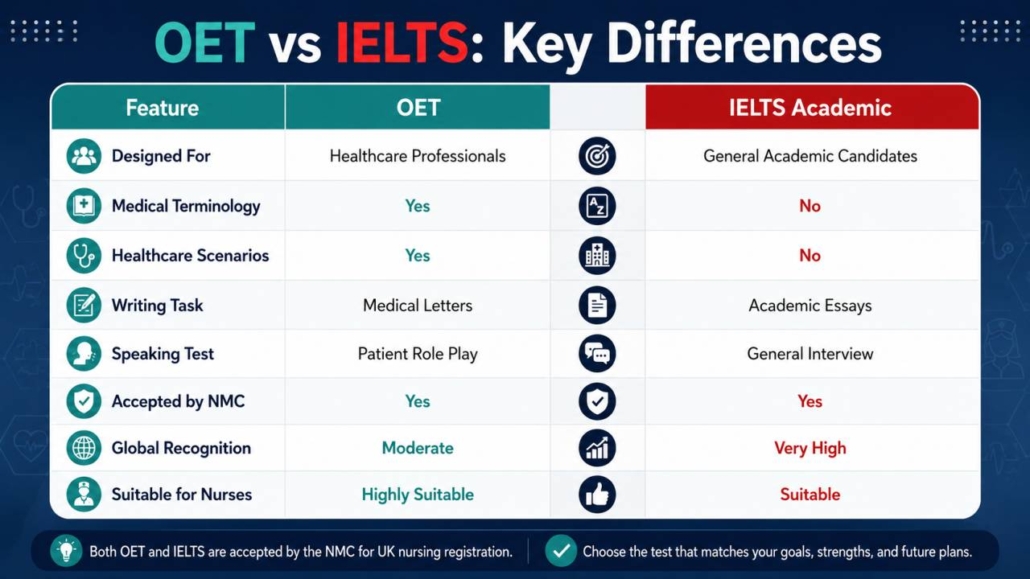
If your primary goal is to work as a nurse in the UK, the Occupational English Test (OET) is often the preferred option because it is specifically designed for healthcare professionals. However, IELTS Academic remains an excellent choice for nurses who want broader international opportunities beyond healthcare. The right exam depends on your career goals, language strengths, and future plans.

OET vs IELTS for Nurses: Understanding the Best Path to a UK Nursing Career

Thousands of international nurses dream of building a successful career in the United Kingdom every year. Before starting the Nursing and Midwifery Council (NMC) registration process, candidates must prove their English language proficiency through an approved exam. This is where the OET vs IELTS for Nurses debate begins.

Many nurses spend weeks comparing exam formats, score requirements, preparation strategies, and difficulty levels. If you are planning to work for the NHS or other healthcare organizations in the UK, choosing the right English proficiency test can save both time and money.

At institutions such as Global NextGen Pro Chandigarh, many aspiring nurses seek guidance on whether OET or IELTS is the better option for UK nursing registration. The answer is not always straightforward because both exams are accepted by the NMC and offer different advantages.

What is OET?

The Occupational English Test (OET) is an English language examination designed specifically for healthcare professionals, including nurses, doctors, pharmacists, and physiotherapists.

Unlike general English exams, OET focuses on real healthcare situations that professionals encounter in hospitals, clinics, and healthcare settings.

The OET Nursing Module includes:

  • Listening to healthcare consultations
  • Reading medical documents
  • Writing referral or discharge letters
  • Speaking through patient-focused role plays

Because of its healthcare-focused content, many nurses find OET more relevant and practical than other English language tests.

What is IELTS Academic?

IELTS Academic is one of the most recognized English language examinations in the world. It evaluates a candidate’s ability to communicate effectively in academic and professional environments.

The IELTS exam format includes:

  • Listening
  • Reading
  • Writing
  • Speaking

Unlike OET, IELTS does not focus on healthcare situations. Instead, candidates must deal with academic reading passages, essay writing tasks, and general discussion topics.

For nurses who may pursue further education, immigration, or international career opportunities beyond healthcare, IELTS offers wider recognition globally.

OET vs IELTS Key Differences

Which is Easier for Nurses?

One of the most common questions among overseas nurses in the UK migration process is:

Which is easier, OET or IELTS?

There is no universal answer, but many healthcare professionals report that OET feels easier because the content is directly related to nursing practice.

For example:

  • OET writing for nurses involves referral letters and patient communication.
  • IELTS writing task for nurses requires academic essays that may be unfamiliar to healthcare workers.

Similarly, OET speaking sessions simulate real patient interactions, while IELTS speaking involves discussing a variety of unrelated topics.

For nurses who use medical terminology daily, OET often feels more natural and comfortable.

NMC English Language Requirements

The Nursing and Midwifery Council accepts both OET and IELTS for nursing registration in the UK.

To meet NMC English language requirements, candidates generally need to achieve the required scores across all four language skills.

Typical requirements include:

OET Score for UK Nurses

  • Grade B in Listening
  • Grade B in Reading
  • Grade B in Speaking
  • Required writing score as per current NMC guidelines

IELTS Score for UK Nurses

  • Overall Band Score: 7.0
  • Minimum required scores in individual modules according to current NMC standards

Candidates should always verify the latest requirements directly from the NMC before booking an examination.

Benefits of OET for Nurses

Healthcare-Focused Content

Every section is designed around real healthcare communication.

Better Professional Relevance

The exam reflects situations nurses experience daily.

Practical Writing Tasks

Instead of essays, candidates complete healthcare-related writing tasks.

Strong Preparation Alignment

Nurses can prepare using their existing medical knowledge.

Accepted by the UK Healthcare Sector

OET is widely accepted for nursing registration and healthcare employment.

Benefits of IELTS for Healthcare Workers

Global Recognition

IELTS is accepted by universities, employers, and immigration authorities worldwide.

Multiple Career Opportunities

Useful for education, migration, and professional development.

Extensive Study Resources

Candidates can access thousands of preparation materials.

International Acceptance

IELTS accepted countries include the UK, Canada, Australia, New Zealand, and many others.

OET Preparation Tips

Many successful candidates at Global NextGen Pro Chandigarh recommend the following preparation strategies:

  • Practice healthcare communication daily.
  • Learn referral and discharge letter structures.
  • Improve medical vocabulary.
  • Complete official OET practice tests.
  • Focus on patient-centered communication.

IELTS Preparation Tips

To improve IELTS performance:

  • Practice essay writing regularly.
  • Develop academic reading skills.
  • Build advanced vocabulary.
  • Take timed mock examinations.
  • Improve speaking confidence through regular conversations.

Common Mistakes Nurses Make

Many nurses fail because they underestimate the exam.

Common mistakes include:

  • Ignoring exam patterns
  • Weak time management
  • Limited writing practice
  • Poor understanding of scoring criteria
  • Lack of mock test experience

Whether you choose OET or IELTS, structured preparation is essential.

Real-Life Career Perspective

Imagine two nurses applying for NHS jobs.

The first nurse chooses OET because she is comfortable with healthcare communication. She successfully completes her OET nursing module and progresses through the NMC registration process.

The second nurse chooses IELTS because she plans to pursue higher education in the future. While preparation takes longer, the broader acceptance of IELTS supports her long-term career goals.

Both nurses eventually secure UK healthcare jobs, proving that success depends more on choosing the exam that matches your strengths than simply selecting the most popular option.

UK vs Australia for Indian Nurses: Which Country Is Better in 2026?

The demand for qualified nurses continues to grow worldwide, creating exciting opportunities for Indian healthcare professionals who want to build an international career. Among the most popular destinations, the United Kingdom and Australia consistently attract thousands of overseas nurses every year due to their strong healthcare systems, competitive salaries, and long-term career prospects.

For Indian nurses planning to work abroad, the debate around UK vs Australia for Indian Nurses has become increasingly common. Both countries offer excellent opportunities, but they differ in terms of registration requirements, salary structures, work culture, immigration pathways, and lifestyle benefits.

If you’re wondering which country is the better choice in 2026, this comprehensive comparison will help you make an informed decision based on your career goals and personal preferences.

Why Indian Nurses Choose the UK and Australia

The UK and Australia have become leading destinations for internationally trained nurses because of their growing healthcare demands and active recruitment of foreign professionals.

Indian nurses are particularly valued because of their clinical expertise, adaptability, strong educational background, and English-language proficiency. Both countries offer opportunities to work in hospitals, community healthcare settings, aged care facilities, mental health services, and specialist medical departments.

In addition to career growth, nurses are often attracted by:

  • Better salary packages than many developing countries
  • International work experience
  • Access to advanced healthcare systems
  • Opportunities for professional development
  • Long-term settlement and immigration options
  • Improved quality of life

While these benefits exist in both countries, the experience can vary significantly depending on where you choose to work.

Nursing Demand and Job Opportunities

One of the biggest advantages of pursuing a nursing career in either the UK or Australia is the strong demand for healthcare professionals.

Nursing Opportunities in the UK

The United Kingdom continues to face a significant shortage of nurses across the National Health Service (NHS) and private healthcare sector. To address workforce gaps, the country actively recruits nurses from India and other nations.

Opportunities are available in:

  • NHS hospitals
  • Community healthcare services
  • Mental health facilities
  • Care homes and nursing homes
  • Specialist healthcare units

The UK’s structured recruitment process often makes it easier for international nurses to secure employment before arriving in the country.

Nursing Opportunities in Australia

Australia is also experiencing increasing demand due to its aging population and expanding healthcare needs. Nurses are required in both urban and regional areas, creating diverse employment opportunities.

Popular employment sectors include:

  • Public hospitals
  • Private healthcare facilities
  • Aged care services
  • Rural and regional healthcare centers
  • Community and home healthcare programs

While both countries offer excellent job prospects, the UK generally provides a more streamlined entry route for internationally qualified nurses.

Registration Process: UK vs Australia

Before practicing professionally, nurses must meet the licensing requirements of their chosen destination.

UK Nursing Registration Process

To work as a registered nurse in the UK, candidates must register with the Nursing and Midwifery Council (NMC).

The process generally includes:

  1. Meeting NMC eligibility requirements
  2. Passing IELTS or OET language tests
  3. Completing the Computer-Based Test (CBT)
  4. Securing employment with an approved healthcare employer
  5. Passing the Objective Structured Clinical Examination (OSCE)
  6. Receiving full NMC registration

The UK pathway is well-structured and widely recognized among international nurses.

Australia Nursing Registration Process

Australia requires registration through the Australian Health Practitioner Regulation Agency (AHPRA).

Depending on qualifications and experience, nurses may need:

  • Qualification assessment
  • English language proficiency evidence
  • Skills verification
  • Additional competency requirements

Many nurses find Australia’s registration process slightly more complex and time-consuming compared to the UK’s NMC pathway.

Salary Comparison: Which Country Pays More?

Salary is often one of the most important factors when deciding where to work.

Australia generally offers higher nursing salaries than the UK. Nurses often benefit from additional allowances, overtime payments, and incentives, especially in regional areas where healthcare professionals are in high demand.

The UK follows a structured NHS pay system that provides predictable salary progression based on experience and professional level. While starting salaries may be lower than in Australia, nurses receive several additional benefits that contribute to overall financial stability.

However, salary figures alone should never be the deciding factor.

A higher salary may not always translate into greater savings if living expenses are significantly higher. Therefore, nurses should evaluate earnings alongside housing, transportation, taxes, and everyday costs.

Cost of Living: What Can Nurses Expect?

Understanding living expenses is essential when comparing international nursing destinations.

Living Costs in Australia

Australia offers an excellent standard of living but can be expensive, particularly in major cities such as Sydney and Melbourne.

Common expenses include:

  • Higher rental costs
  • Transportation expenses
  • Utility bills
  • Childcare costs

However, higher salaries often help offset these expenses.

Living Costs in the UK

The UK offers a wider range of living options depending on the region. While London is known for its high cost of living, many other cities provide more affordable lifestyles.

Popular nursing destinations outside London often offer:

  • Lower housing costs
  • Reduced commuting expenses
  • Better savings potential
  • Improved work-life balance

Many Indian nurses find that they can manage their finances effectively while still enjoying a comfortable lifestyle in the UK.

Work-Life Balance and Working Environment

Modern nurses increasingly prioritize work-life balance alongside salary and career growth.

Australia has built a strong reputation for promoting employee wellbeing. Many healthcare facilities emphasize manageable workloads, flexible scheduling, and a healthy balance between professional and personal life.

The UK also offers supportive work environments, particularly within the NHS. Nurses benefit from:

  • Paid annual leave
  • Maternity and paternity benefits
  • Pension schemes
  • Professional development opportunities
  • Structured career progression

Work experiences can vary depending on the employer and location, but both countries provide rewarding healthcare careers.

Immigration and Permanent Residency Opportunities

For many Indian nurses, working abroad is not only about career advancement but also about securing a stable future for themselves and their families.

Australia’s Immigration Pathways

Australia is often viewed as one of the most attractive countries for skilled migration.

Benefits include:

  • Skilled migration programs
  • Employer-sponsored visas
  • Regional migration opportunities
  • Clear permanent residency pathways

Many nurses choose Australia specifically because of its long-term settlement opportunities.

UK’s Long-Term Settlement Options

The UK offers the Health and Care Worker Visa, which allows eligible nurses to live and work in the country.

Advantages include:

  • Reduced visa fees
  • Faster visa processing
  • Family sponsorship opportunities
  • Route to permanent settlement after qualifying periods

The UK remains one of the most accessible destinations for nurses seeking international work experience and long-term stability.

Language and Cultural Adaptation

Language can significantly influence a nurse’s ability to adapt successfully.

Fortunately, both the UK and Australia operate primarily in English-speaking healthcare environments, making the transition smoother for many Indian nurses.

In addition, both countries have large Indian communities that help newcomers settle more comfortably. Access to familiar food, cultural events, religious centers, and support networks often makes adaptation easier for overseas professionals.

Many Indian nurses report feeling welcomed and supported in both countries, particularly within multicultural healthcare teams.

Career Growth and Professional Development

A successful nursing career involves more than securing a job—it also requires opportunities for advancement.

The UK offers highly structured career pathways through the NHS. Nurses can specialize in areas such as:

  • Critical care
  • Oncology
  • Mental health
  • Emergency nursing
  • Pediatric nursing
  • Surgical nursing

The NHS also provides leadership and management development programs for experienced professionals.

Australia similarly offers excellent growth opportunities, especially for nurses interested in advanced practice roles, aged care, and specialist healthcare services.

Both destinations encourage continuous learning and professional development throughout a nurse’s career.

UK vs Australia: Which Country Is Better for Indian Nurses in 2026?

There is no universal answer because every nurse has different priorities.

The UK may be the better choice if you are looking for:

  • A structured NMC registration process
  • Strong NHS employment opportunities
  • Easier access to international nursing jobs
  • Extensive clinical exposure
  • Professional specialization options

Australia may be the better choice if you prioritize:

  • Higher earning potential
  • Excellent work-life balance
  • Skilled migration opportunities
  • Long-term permanent residency pathways
  • Outdoor lifestyle and climate

Ultimately, the best destination is the one that aligns with your professional ambitions, financial goals, family plans, and lifestyle preferences.

Take the Next Step Towards Your International Nursing Career

Whether you choose the UK or Australia, proper preparation is the key to success. Understanding registration requirements, licensing processes, immigration pathways, and career opportunities can help you make a confident and informed decision.

At Global Nextgen Pro, we help aspiring nurses navigate their international career journey through expert guidance on NMC registration, CBT preparation, OSCE preparation, documentation support, and UK nursing career opportunities.

With the right support and preparation, your dream of working as an international nurse can become a reality in 2026 and beyond.

OSCE Preparation for Nurses: A Complete Guide to Passing with Confidence

The United Kingdom continues to be one of the most popular destinations for nurses looking for better career opportunities, professional growth, and international work experience. To work as a registered nurse in the UK, internationally educated nurses must successfully complete the Objective Structured Clinical Examination (OSCE).

For many candidates, the OSCE can feel challenging because it tests practical nursing skills, communication abilities, and professional decision-making in real-life clinical situations. However, with the right preparation and practice, passing the exam is completely achievable.

In this guide, we will discuss the most effective OSCE preparation for nurses and share practical OSCE preparation tips that can help you approach the exam with confidence.

Understanding the OSCE Exam

Before starting your preparation, it is important to understand what the OSCE exam is and why it is required.

The OSCE is a practical examination designed to assess whether a nurse can safely and effectively provide patient care according to UK healthcare standards. During the exam, candidates move through different stations where they perform specific nursing tasks while being observed by examiners.

These stations may include patient assessments, medication administration, communication scenarios, infection prevention procedures, and other essential nursing skills.

Unlike written exams, the OSCE focuses on how well you apply your knowledge in practical situations.

Why Proper OSCE Preparation Matters

Many nurses underestimate the importance of structured preparation. While clinical experience is valuable, the OSCE follows specific guidelines and assessment criteria that candidates must meet.

Good OSCE preparation for nurses helps you:

  • Understand the exam structure
  • Improve clinical performance
  • Build confidence
  • Reduce exam anxiety
  • Avoid common mistakes
  • Manage time effectively during stations

The more familiar you are with the exam process, the more comfortable you will feel on exam day.

Also Read This: Why OSCE Training is Crucial for International Nurses Moving to the UK

Start with the OSCE Blueprint

One of the most important OSCE preparation tips is to review the official exam blueprint and guidelines provided by the testing authority.

The blueprint outlines the skills, procedures, and competencies that may be assessed during the examination. It serves as a roadmap for your preparation and helps you focus on the areas that matter most.

Instead of trying to study everything at once, use the blueprint to create a structured study plan and prioritize key nursing skills.

Focus on Core Clinical Skills

The OSCE evaluates practical nursing abilities, so developing strong clinical skills should be a major part of your preparation.

Candidates should spend time practicing essential nursing procedures such as:

  • Measuring vital signs
  • Patient assessment
  • Infection prevention and control
  • Medication administration
  • Documentation
  • Patient education
  • Safe communication techniques

Regular practice helps improve accuracy, speed, and confidence. The more often you perform these skills, the more natural they become during the exam.

Develop Strong Communication Skills

Communication plays a significant role in every OSCE station. Examiners assess not only what you do but also how you interact with patients.

Many candidates focus heavily on technical skills and forget that effective communication is equally important.

When speaking with patients, remember to:

  • Introduce yourself clearly
  • Explain procedures in simple language
  • Maintain professionalism
  • Listen carefully to patient concerns
  • Show empathy and respect
  • Confirm patient understanding

Good communication creates a positive patient experience and demonstrates safe nursing practice.

Practice Under Timed Conditions

One of the biggest challenges during the OSCE is time management.

Most stations have a strict time limit, and candidates must complete tasks within the allocated time. Even nurses with strong clinical knowledge can struggle if they are unable to manage their time effectively.

A useful strategy is to recreate exam conditions during practice sessions. Use a timer and perform procedures exactly as you would during the real examination.

This approach helps you become comfortable working under pressure while improving your speed and efficiency.

Learn from Mock OSCE Sessions

Mock examinations are one of the most valuable tools for OSCE preparation for nurses.

A mock OSCE allows you to experience the exam environment before the actual test. It helps identify strengths and weaknesses while providing an opportunity to improve performance.

During mock sessions, focus on:

  • Following correct procedures
  • Communicating effectively
  • Managing time
  • Handling unexpected situations
  • Remaining calm under pressure

Feedback from experienced educators or mentors can help you correct mistakes and improve your overall performance.

Understand Infection Prevention and Patient Safety

Patient safety is at the heart of nursing practice, and it is a key area assessed during the OSCE.

Candidates must demonstrate safe and professional behavior throughout every station.

This includes:

  • Proper hand hygiene
  • Correct use of personal protective equipment (PPE)
  • Safe medication practices
  • Accurate patient identification
  • Risk assessment
  • Infection control procedures

Examiners pay close attention to these details because they directly impact patient care and safety.

Stay Calm and Manage Exam Anxiety

Feeling nervous before the OSCE is completely normal. In fact, many candidates experience anxiety regardless of their experience level.

One of the most practical OSCE preparation tips is to develop techniques for staying calm during the exam.

Simple strategies include:

  • Deep breathing exercises
  • Positive self-talk
  • Adequate sleep before the exam
  • Regular practice sessions
  • Maintaining a healthy study routine

Confidence comes from preparation. The more prepared you are, the less anxious you will feel on exam day.

Create a Consistent Study Plan

Successful candidates usually prepare over several weeks rather than trying to learn everything at the last minute.

A well-organized study plan should include:

  • Daily skill practice
  • Review of clinical guidelines
  • Communication exercises
  • Mock OSCE sessions
  • Self-assessment and revision

Consistency is far more effective than long, exhausting study sessions. Even a few focused hours each day can make a significant difference over time.

Common Mistakes to Avoid

During OSCE preparation, many candidates make avoidable mistakes that can affect their performance.

Some common mistakes include:

  • Ignoring communication skills
  • Poor time management
  • Inadequate practice
  • Skipping mock exams
  • Forgetting infection control steps
  • Rushing through procedures
  • Not reviewing official guidelines

Being aware of these mistakes can help you avoid them and improve your chances of success.

Ready to Pass the OSCE with Confidence?

Preparing for the OSCE exam requires more than just clinical knowledge. Candidates need the right guidance, practical training, and a clear understanding of what examiners expect during each station.

At Global NextGen Pro, we are committed to helping nurses prepare confidently for their OSCE journey. Our support focuses on building strong clinical skills, improving communication techniques, and helping candidates become familiar with real-world exam scenarios.

Whether you are an internationally educated nurse planning to work in the UK or preparing for your next step in professional registration, structured guidance can make a significant difference in your preparation process.

With the right approach, consistent practice, and expert support, nurses can improve their confidence and perform effectively during the OSCE examination.

Frequently Asked Questions (FAQs)

What is the OSCE exam for nurses?

The Objective Structured Clinical Examination (OSCE) is a practical exam that assesses a nurse’s ability to provide safe and effective patient care. It evaluates clinical skills, communication, professional behavior, and decision-making in simulated healthcare scenarios.

How long should I prepare for the OSCE exam?

Preparation time varies for each candidate. Most nurses spend between four and twelve weeks preparing, depending on their experience level, clinical background, and familiarity with the exam format.

What are the most important OSCE preparation tips?

Some of the most effective OSCE preparation tips include practicing clinical skills regularly, improving communication abilities, reviewing clinical guidelines, attending mock exams, and managing time effectively during practice sessions.

Is the OSCE difficult to pass?

The OSCE can be challenging because it assesses practical performance rather than theoretical knowledge alone. However, candidates who prepare consistently and practice under exam-like conditions often perform well and pass successfully.

What skills are tested in the OSCE exam?

The exam commonly tests patient assessment, infection prevention and control, medication administration, communication skills, documentation, patient education, and professional nursing practice.

Can international nurses pass the OSCE on their first attempt?

Yes. Many internationally educated nurses pass the OSCE on their first attempt through structured preparation, regular practice, and a clear understanding of the exam requirements.

How can mock OSCE sessions help?

Mock OSCE sessions help candidates experience the exam environment before test day. They improve confidence, identify weaknesses, strengthen time management skills, and provide valuable feedback for improvement.

Where can nurses get support for OSCE preparation?

Nurses can seek guidance through professional training providers, study groups, mock examinations, online learning resources, and dedicated preparation programs such as those offered by Global NextGen Pro.